
04Aug

The Acceleration of AI and Its Impact on Leaders and Businesses

Artificial Intelligence (AI) is no longer a futuristic concept; it’s now a reality, transforming industries and redefining how businesses work. For business leaders, staying ahead of this technological curve is not just an advantage – it’s a necessity; they must grasp the speed at which AI is advancing and the implications of the AI Act.

The Acceleration of AI

AI has grown rapidly in recent years from streamlining day-to-day tasks to extracting intelligent insights from data analysis to bolster operational efficiency and decision-making processes. Amazon, Google, IBM, and other companies already use AI to improve customer experiences, streamline supply chains, and create new products and services.

The benefits of AI are clear:

  • Increased Efficiency: AI can process vast amounts of data at speeds impossible for humans, leading to quicker and more accurate decision-making.
  • Cost Savings: Businesses can reduce labour costs and allocate resources to more strategic initiatives by automating repetitive tasks.
    Enhanced Customer Experience: AI-driven chatbots and personalised recommendations enhance customer satisfaction and loyalty.
  • Innovation: AI enables innovation in product creation and delivering new business models.

Implications of AI in Companies

While the advantages of AI are substantial, the implementation of AI in companies also brings about several implications that need to be carefully considered. One of the primary concerns is the ethical use of AI. Businesses must ensure that AI systems are used responsibly, without bias or discrimination, and with respect for privacy and human rights. As AI becomes more integrated into business operations, it will also significantly impact the workforce. Automating tasks may lead to workforce displacement, necessitating companies to retrain and upskill employees to adapt to new roles.

Another critical implication is related to data security and privacy. The extensive use of AI requires collecting and processing massive amounts of data, making businesses vulnerable to data breaches and cyber-attacks. Strict compliance with data protection regulations becomes essential to safeguard sensitive information. Additionally, the adoption of AI can introduce legal and regulatory challenges. Companies must stay informed about regulatory frameworks, such as the AI Act, to ensure they comply with new laws governing the use of AI technologies.

Finally, businesses need to consider the financial implications of AI deployment. While AI can lead to long-term cost savings, the initial investment in AI infrastructure, software, and training can be substantial. Companies must weigh these costs against the potential benefits and plan their budgets accordingly. While AI presents transformative opportunities for businesses, it also necessitates careful consideration of ethical, workforce, security, regulatory, and financial factors.

“AI is not just a technological advancement; it’s a paradigm shift that requires us to rethink how we integrate innovation with ethical responsibility. At Lim-Loges & Masters, we believe in empowering people to navigate this transformation with confidence and integrity.” Lelia Lim, Founder and Senior Partner, Lim-Loges and Masters.

The AI Act and its Implications

With this rapid advancement of AI comes the need for regulatory frameworks to ensure ethical and responsible use. The European Commission has proposed the AI Act, a comprehensive regulatory framework that governs the deployment of AI technologies across various sectors.

Key Points of the AI Act:

  • Risk-Based Classification: AI systems are classified based on the risk they pose, ranging from minimal risk to unacceptable risk. High-risk AI systems will be subject to strict obligations before deployment.
  • Transparency Requirements: AI systems must be transparent in operations, ensuring users know they are interacting with AI. This includes labelling requirements for AI-generated content.
  • Accountability and Governance: Companies deploying AI technologies must implement robust governance frameworks to ensure compliance with the AI Act. This includes maintaining documentation, conducting risk assessments, and providing human oversight.

How the AI Act Will Affect Companies and Leaders

The AI Act represents both a challenge and an opportunity for business leaders. On one hand, compliance with the regulatory framework will require significant investment in governance and risk management. On the other hand, adhering to the AI Act can enhance a company’s reputation and build trust with customers and stakeholders.

Here are some critical considerations for business leaders:

  • Governance and Compliance: Establishing a robust governance framework is crucial. This includes appointing AI compliance officers, conducting regular audits, and ensuring all AI deployments are transparent and accountable.
  • Risk Management: Identifying and mitigating risks associated with AI technologies should be a priority. This involves conducting thorough risk assessments and implementing controls to mitigate identified risks.
  • Ethical AI: Beyond compliance, business leaders should strive to adopt ethical AI practices. This includes ensuring fairness, avoiding biases, and promoting transparency in AI systems.
  • Innovation and Adaptation: While regulatory compliance may seem burdensome, it can drive innovation and competitive advantage. Business leaders should view the AI Act as an opportunity to develop cutting-edge solutions that align with regulatory requirements.
  • Its People: The success of AI implementation relies heavily on the people behind it. Cultivating a workforce skilled in AI technologies and understanding regulatory requirements is essential. Ongoing training and development programs can help employees stay abreast of the latest advancements and operational best practices. Moreover, fostering a culture that values ethical considerations and responsible AI use will ensure that the technology is deployed in ways that benefit both the organisation and society. Involving diverse teams in AI projects can also help in creating systems that are more inclusive and less prone to biases.

Navigating AI Adoption

The acceleration of AI presents immense opportunities for businesses to innovate, enhance efficiency, and deliver superior customer experiences. However, it also brings challenges, particularly in navigating the regulatory landscape established by the AI Act.

At Lim-Loges & Masters, we specialise in helping businesses adopt AI initiatives and adhere to the stringent requirements of the AI Act through their people. We focus on empowering people with the necessary skills, knowledge, and resources to implement AI solutions responsibly and effectively.

Business leaders must stay informed about the evolving regulatory environment and proactively adapt their strategies to ensure compliance. By partnering with Lim-Loges & Masters, you can harness AI’s full potential while building trust and credibility with your customers and stakeholders through people-centric strategies.


04Aug

Skills-Based Hiring: The Talent Revolution Transforming Asia in 2026

Asia is experiencing a revolution in hiring procedures and processes. With the impact of digital transformations and global competition on businesses, talent acquisition is changing. Skills-based hiring is the new approach. This paradigm shift changes the focus from candidate qualifications and credentials to their skills and abilities.

As some organisations navigate the complexities of scaling in Asia, this change offers them the opportunity to build diverse, high-performing teams while closing talent gaps. Skills-based hiring in Southeast Asia, along with positive changes in the region’s talent pool, is creating a new future of work.

The Decline of Credential-First Hiring

For decades, having a degree was a reliable sign of a person’s potential. In today’s fast-moving business environment, the skills needed to succeed, such as AI collaboration, data fluency, and cross-functional problem-solving, are often gained outside formal education.

As a result, businesses globally, such as IBM and Google, have reframed their hiring and are focusing on ‘real-world’ skills and hiring without strict degree requirements. This approach has uncovered top talent from unconventional backgrounds, such as self-taught developers or marketing professionals who obtained their skills through online courses.

The focus has shifted from “What degree do you have?” to “What can you deliver?”

Southeast Asia: From Talent Gaps to Talent Hubs

Southeast Asia has the opportunity to lead the skills-based hiring revolution. The region, once known for exporting labour, is now a global talent centre, attracting investment and innovation while retaining skilled talent. Many factors are driving this transformation.

  1.  Demographic Advantage: With a median age under 30, Southeast Asia has a younger, more dynamic workforce. Countries like Vietnam and Indonesia are producing more STEM and business graduates to meet the demands of the digital economy.
  2. Digital Transformation: The region’s internet economy is projected to exceed $330 billion by 2025, driven by startups, e-commerce, and technological advancements. Jakarta, Ho Chi Minh City, and Manila are becoming global technology hubs.
  3. Policy SupportVarious governments, such as Singapore and Malaysia, are implementing initiatives like the Overseas Networks & Expertise (ONE) Pass and the DE Rantau Nomad Pass, respectively, to attract and retain talent. These policies are creating a more unified, mobile workforce throughout ASEAN.
  4. Global Demand: As developed markets experience the effects of ageing populations and labour shortages, Southeast Asia’s young, skilled professionals are increasingly sought after. The region is not just filling roles, it’s driving global innovation.

What Skills-Based Hiring Looks Like

A skills-first approach entails a fundamental change, but not a dilution of quality. It actually improves hiring quality if implemented correctly. Here are some of the best practices currently being adopted by forward-thinking companies:

  • Greater Attention to Skills: Job descriptions are becoming outcomes- and skills-focused rather than just listing a bunch of educational qualifications. The prompt, “Can you analyse customer data to identify growth opportunities?” replaces “Bachelor’s degree required.”
  • Practical Assessments: The interview process now includes case studies, real-world problem-solving, and portfolio assessments to demonstrate and assess skill proficiency.
  • Expanding Talent Pools: Removing degree filters opens the door to a more diversified candidate base. The World Economic Forum estimates this approach can expand talent pools by up to 10 times.
  • Internal Mobility: High performers are rewarded based on their achievements, not their academic credentials, fostering a culture of meritocracy.

Addressing Talent Gaps in ASEAN’s Digital Economy

Despite its advantages, Southeast Asia faces significant challenges in aligning education with industry needs. An ASEAN-BAC report for 2025 shows a paradox: more youths are graduating, yet fewer are ready for jobs. The region’s digital growth will require an additional 8.9 million ICT professionals by 2030.

To close this gap, ASEAN nations are investing in upskilling, digital bootcamps, and employer-driven apprenticeships across ASEAN member countries. The region’s Digital Nomad Visa and Graduate Work Visa initiatives are also enhancing professional mobility, contributing to the region’s integrated labour market.

The Competitive Edge of Skills-Based Hiring

Companies practising skills-based hiring are more than just trend-setters; they’re gaining a sustainable competitive advantage. These businesses are diversifying their skill sets and building robust teams, thereby increasing their odds of success in navigating the volatile, uncertain business landscape.

When thinking about 2026, leaders must answer one crucial question: Will you adapt to this talent revolution, or risk being left behind?

Your Next Move

Moving to skills-based hiring represents a fundamental change in how you build your team. It means thinking strategically, executing operationally, and maintaining compliance focus as you scale across markets.

At Lim-Loges and Masters, we focus on helping companies manage changes to their talent strategies. If you are ready to implement skills-based hiring and improve your talent strategy, let’s talk.

04Aug

Driving Agribusiness Growth in Asia Pacific – a Case Study

Overcoming a Critical Talent Shortage

The agribusiness sector in the Asia Pacific region is expanding rapidly, but this growth is often slowed by a significant challenge: a scarcity of skilled, senior-level talent. Companies struggle to find leaders who not only have deep industry knowledge but also possess the specific skills to navigate the complexities of the regional market.

A leading multinational agribusiness client faced this exact problem. They needed to fill a critical C-suite position but were unable to identify suitable candidates through their traditional recruitment channels. The role demanded a unique combination of technical expertise, strategic leadership, and a profound understanding of the diverse Asian market landscape. The search had stalled, putting key business objectives at risk.

A Specialised, High-Touch Recruitment Strategy

Lim-Loges & Masters (LLM) was engaged to find the ideal candidate. Our approach is built on deep domain expertise and a strictly retained fee structure, which fosters a trusted partnership from day one.

Our solution involved several key steps:

  1. Deep Dive & Market Mapping: We leveraged our intimate knowledge of the agribusiness supply chain to understand the precise challenges and opportunities of the role. Our team, fluent in multiple local languages, initiated a confidential search that leveraged our extensive global network to reach both active and passive candidates across Asia and beyond.
  2. Rigorous Vetting: We moved beyond standard resume reviews. Our process included comprehensive reference checks and academic verifications to ensure the credibility and calibre of each potential candidate. This meticulous approach allowed us to guarantee the quality of the talent presented.
  3. Speed and Confidentiality: Understanding the urgency, we committed to and successfully delivered a shortlist of highly qualified, pre-vetted profiles within just 4 weeks of the search start, all while maintaining the highest levels of confidentiality.
  4. Holistic Onboarding Support: Our engagement didn’t end with the placement. We provided a personal onboarding service for the first 12 months, offering dedicated support to help the new executive integrate seamlessly into the company’s culture and start delivering value from day one.

Securing a High-Impact Leader and Driving Long-Term Success

Our specialised approach delivered exceptional, measurable outcomes that far exceeded the client’s expectations.

  • 98% Placement Rate: We successfully placed a top-tier candidate who perfectly matched the client’s complex requirements.
  • 100% Retention Beyond One Year: The successful placement not only adapted quickly but has also become a key driver of the company’s regional strategy, remaining with the organisation well beyond the first year.
  • 90% Repeat Client Rate: This success reinforced our client’s trust in our process, contributing to our 90% repeat business rate. Our focus on professionalism, integrity, and speed consistently delivers results that build lasting partnerships.

Is your organisation facing challenges in securing top-tier talent in the agribusiness sector? Let’s connect to discuss how our specialised expertise can help you build the leadership team you need to thrive.

03Aug

Disrupt or Risk Disruption- How Organisations In Asia Pacific Are Leveraging Diversity To Drive Innovation

“Disruption is inevitable, so we need to embrace it.” Samson Li, Managing Director, Asia.

All this means that CEOs are now under significant pressure to accelerate innovation in their organizations and to disrupt their businesses and markets before they are themselves disrupted. The stakes are high: a study from the John M. Olin School of Business at Washington University estimates that 40 percent of today’s Fortune 500 companies that are also on the S&P 500 will no longer exist in 10 years’ time.

Lim-Loges & Masters recently gathered insights on digital transformation and change from a panel of senior leaders within Asia Pacific’s B2B and B2C food sectors. The group, which participated in a roundtable in Singapore in late 2017, included investors and representatives from major agribusiness and food chain enterprises including DSM, Crisp Sensation Asia, Emeterra, Nutreco NV and the State General Reserve Fund – Ministry of Finance (Oman). This white paper summarises their views.

Click here to download chinese version.

03Aug

Readying Asia Pacific’s Organisations For The 4IR: The Role Of The HR Strategist

Lim-Loges & Masters recently gathered insights on HR’s role in propelling the Fourth Industrial Revolution (4IR) from a panel of senior leaders within Asia Pacific. The group, which participated in a roundtable in Singapore in late 2018, included representatives from major enterprises including Dole Asia Holdings, Hehsed Consulting, Intel Wise Group, Kimberly-Clark, SABIC Asia Pacific, Sanofi Group and Volvo SEA. This white paper summarises their views.
03Aug

Business Success in Asia starts with a Global Mindset

Lim-Loges & Masters and the Human Capital Leadership Institute recently brought together a panel of senior business leaders for a roundtable discussion in Singapore on the leadership capabilities needed for business success in Asia. The panel comprised senior representatives of major enterprises from the Asia Pacific, including Cloudflare, Hexagon Metrology Asia Pacific, IMCD Asia, Lenovo Asia Pacific, Microsoft Asia Pacific, Syngenta Asia Pacific and Westpac Asia Pacific.

Download mandarin copy here

03Aug

Winning in the New Workplace:New Business Expectations — Insights from CEOs in Asia

Asia’s most senior business leaders share their insights with us. Lim-Loges & Masters gained deep knowledge of how c-suite leaders across Asia are managing the accelerated changes caused by Covid-19, including advancing digital trends, employee upskilling in a data-driven world and value creation through innovative new business models for long-term business growth. Our interviewees include CEOs and experts from global companies across sectors including BMW Group, Mondelez International, Limagrain, Eu Yan Sang and Syngenta

03Aug

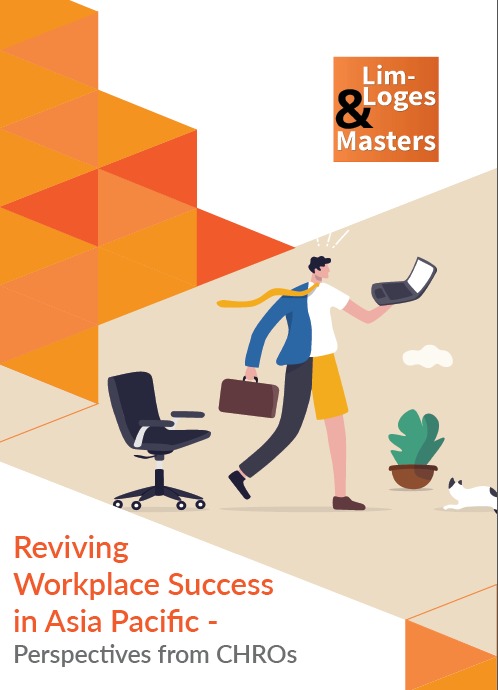
Reviving Workplace Success in Asia-Pacific: Perspectives from CHROs

Our new whitepaper, ‘Reviving Workplace Success in Asia-Pacific – Perspectives from CHROs’, offers detailed insights from expert HR leaders across the Asia-Pacific region. Our interviews with experienced Chief Human Resource Officers (CHROs) of top-tier organisations, have enabled us to provide a comprehensive look at the key trends, challenges, and best practices in Human Resources for driving workplace success in the Asia-Pacific region.

Achieve Better Outcomes with Insights from Expert HR Leaders

Through this research, you will gain an understanding of the unique needs of employees today, the impact of digital transformation, and the strategies and technologies needed to achieve successful business outcomes in this dynamic region.

Whitepaper features:

  • A comprehensive examination of workplace success opportunities in the Asia-Pacific region and how CHRO’s can drive these initiatives.
  • Exploration of the challenges of digital transformation, talent development strategies, and corporate culture to identify best practices for reviving workplace success.
  • Rich content references, recent research studies and interviews with leading industry experts with actionable advice and recommendations on how companies can create successful workplaces in the Asia-Pacific region.

Whitepaper benefits:

  • Gain insights into the current state of the Asia-Pacific workplace environment and understand the challenges and opportunities for fostering success in the region.
  • Learn from HR industry experts and draw inspiration from real-life case studies as you develop strategies for your own organisation’s workplace revival efforts.
  • Develop a better understanding of cultural diversity in the workplace – learn how cultural dynamics can shape employee performance and uncover key considerations when building diverse teams across the region.

At Lim-Loges & Masters, we are confident our Whitepaper will be a valuable resource for senior leaders across the Asia-Pacific region, and are proud to be able to share it with you.

Unlock workplace success in the Asia-Pacific and beyond! Download our new Whitepaper ‘Reviving Workplace Success in Asia-Pacific – Perspectives from CHRO’s’ now!

03Aug

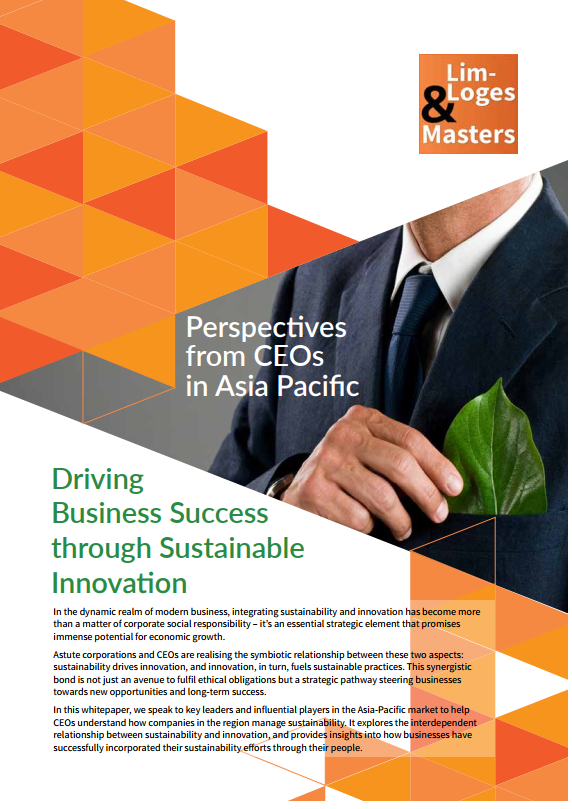
Driving Business Success through Sustainable Innovation in Asia Pacific

Driving Business Success through Sustainable Innovation

In a rapidly evolving business landscape, sustainability has become the cornerstone of not just ethical operations but also commercial success. Our latest whitepaper, “Driving Business Success through Sustainable Innovation,” is crafted specifically for leaders keen to harness the transformative power of ESG and eco-conscious strategies.

This whitepaper engages in in-depth conversations with prominent CEOs, industry leaders, and major influencers within the Asia-Pacific region. The purpose is to delve into corporate strategies for managing sustainability. It sheds light on the synergy between sustainability and innovation, and highlights how various organisations have effectively integrated sustainability initiatives through their people.

The Features of Our “Driving Business Success through Sustainable Innovation” Whitepaper:

  • Comprehensive Analysis: Understand the vital connection between sustainability and business success with real-world examples, especially in Asia-Pacific.
  • Actionable Strategies: Gain insight into practical steps to integrate sustainable innovation into your organisation through your people.
  • Cutting-Edge Research: Leverage the latest findings and data driving the shift towards sustainability in top-performing companies around the globe.
  • Expert Opinions: Hear from industry leaders about the challenges and successes of embedding ESG goals within business operations.

Benefits You Will Derive:

  • Stay Ahead of the Curve: Equip yourself with the foresight to anticipate and lead market trends in sustainability.
  • Create Value: Redefine sustainability as a strategic investment that can generate significant cost savings and open new revenue streams.
  • Foster a Culture of Innovation: Learn how to engage and empower your team to contribute to your company’s sustainable vision and objectives.
  • Enhance Brand Reputation: Position your company as a leader in sustainability, building trust and loyalty with customers who prioritise eco-conscious products and services.

Don’t miss this pivotal resource. Download “Driving Business Success through Sustainable Innovation” today and pivot your business strategy to meet the demand for greener solutions, thrive, and set new benchmarks in your industry.

Your blueprint for sustainable innovation awaits.

03Aug

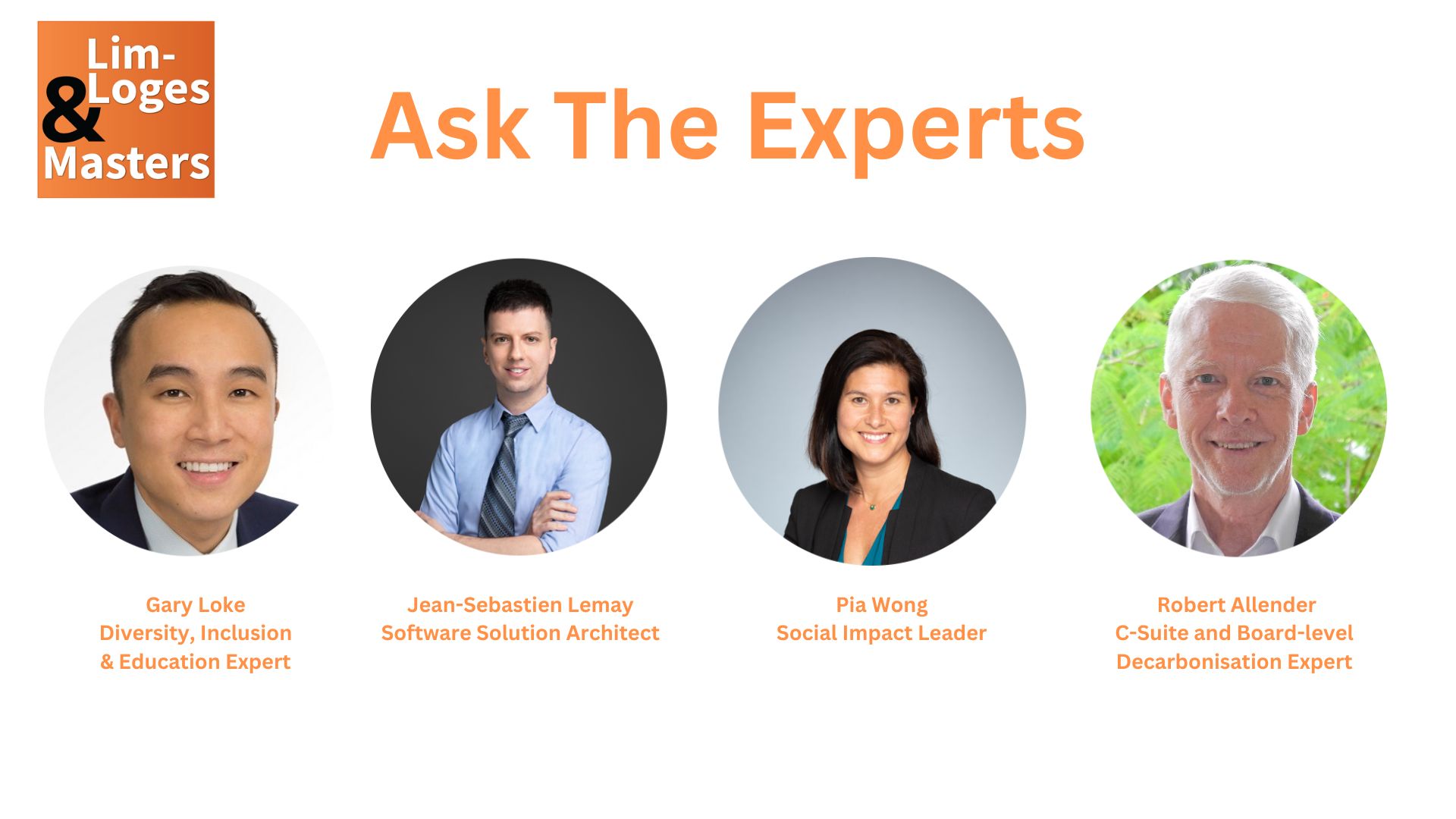
Mastering Scope 3 Emissions: Expert Insights for Effective Management with Robert Allender, C-Suite and Board-level Decarbonisation Expert

I have been involved with Scope 3 since it was born in 1998 – that’s when the greenhouse gas protocol came up with the definitions of Scope 1, Scope 2 and Scope 3.

What are Scope 1, Scope 2 and Scope 3 Emissions?

  • Scope 1 is the energy of the emissions from operations inside the companies’ four walls.
  • Scope 2 is the emissions mostly from purchased energy.

In fact, for those of us in this part of the world, where district cooling is not that uncommon, I could point out that when I first read about these scopes, the people who wrote the definitions hadn’t thought of district cooling; they only mentioned district heating, so I communicated with them and asked them to remedy that.

Scope 3 is the emissions from the two ends of the scale, which are the things that happen before something arrives in the company. The things that happen after something leaves a company’s doors. Most of us will spend our time concentrating on Scope 3, on supply chain emissions. However, plenty of companies are not very serious about their customers’ emissions, particularly companies that, for example, are selling automobiles or other energy-consuming things.

Where do Greenhouse gases come from?

I always remind everyone that we’re here for this thin blue line, our atmosphere. This tiny bit of distance between land and the darkness of space is what keeps us all alive. We’ve lived with Goldilocks climate for thousands of years. Still, as you’ll all know, we’re messing it up because we’re pouring enormous amounts of greenhouse gas, carbon dioxide and other greenhouse gases into the atmosphere.

I would also like to point out quickly that some of these greenhouse gases come from industrial processes and some from methane from waste. A fair bit comes from agriculture and land use – when you chop down a forest, you immediately reduce the amount of carbon oxide absorbed from the atmosphere, so equally, you’re adding to the amount that stays up there.

However, as you can see from this chart from the World Resources Institute, 73% of all greenhouse gas emissions come from energy use, and we need to understand that when we’re thinking about Scope 3, it’s about energy use. I think 11 or 12 of those 73% are from residential energy use and 61% or 62% are from business or organisational energy use. So, it’s very clear what the culprit is and what we need to tackle.

Scope 3 is nothing new

I would also like to point out that it’s not something new, although we’re getting very urgent about Scope 3. In 1856, a woman in upstate New York in the United States – not a scientist, I guess you can call her an amateur scientist – figured out that burning coal in large quantities would increase carbon dioxide in the atmosphere. She calculated that this was going to create some sort of global warming. She managed to find a university professor who partnered with her so she could publish a paper because she wasn’t a professional scientist.

So, we have a record from 1850, which tells us that we knew about these three years before the first commercial oil well was built in the United States, so she was certainly ahead of her time. I would also like to remind people that back in 1965, US President Lyndon Johnson was already telling people he wanted Congress to tackle the problem because he said carbon dioxide is what is altering the composition of the atmosphere.

These are the Scopes you’re well familiar with, and perhaps many of you will have seen this graph too, reminding us the orange line is the Scope 3 percentage that the World Resources Institute calculated for different industry types. The financial services sector has close to 100% of carbon emissions. Many other industries, which you think would be pretty energy-intensive, except for really energy-intensive things like making cement and steel, in metals and mining, for example, even the oil and gas industry, most of their emissions come from Scope 3.

Some mental models to help you understand Scope 3

So, it’s super important that we understand that this is a high priority. I also want to share some mental models I use to help people understand Scope 3. I usually give a long talk about these, so I will try to say them in two sentences – I’m not trying to teach you the basics of Scope 3 in this little session. Still, I want to give you the benefit of some thinking, which has helped people understand Scope 3 more clearly.

  • The first mental model that is very helpful is to think of Scope 3 as the progression of phases. Often, in a conversation about Scope 3, I find people jumping around different parts of these phases without even perhaps recognising that they are phases.
  • Having conversations about reporting, which are the material and Scope 3 emissions, and how they will deal with them, and having that kind of mixed understanding isn’t too helpful. So, I always encourage people to stop and break down their understanding of Scope through emissions into these 4 phases.
  • I also suggest that while Scope 1 and 2 have been quite well addressed by many corporations worldwide, Scope 3 is proving a challenge to virtually every corporation required to disclose their Scope 3 numbers.

I put it this way: I say, well, Scope 1 and Scope 2 could be dealt with like a project. I used this graphic – if a company decides to stop burning oil to produce heat and switch to electricity, it just requires a person in authority to say, “Take away the boiler, and we’re going to replace it with an electric heater”, and as long as the electricity is carbon-free, they’ve immediately addressed the entire Scope 1 problem. And Scope 2 can be addressed like that as well. If you need clean electricity, but your factory isn’t in the right place, then you probably better think about putting your next factory in a place where it’s readily available. Scope 3 is, by definition, not a project; it’s basically a new way of doing business. It’s an internal new way of doing business, so it’s not a project; it’s a process.

  • The third mental model that I encourage people to think about is who’s pushing for Scope 3 recognition, calculation and disclosure, and to understand the motivation of those parties or the influence of those parties. Do not simply assume that a stock exchange has told the company to do it and that the companies have told their suppliers to do it. We’re understanding the motivation of the party in much more depth.

Above all, scope 3 is being pushed by governments because they know they need to stop carbon emissions if they want the country or their city to survive in the next 50 years. Long-term investors are particularly interested in Scope 3 disclosure because they want their investments to be worth something 20 and 30 years from now. These days, many of us know that companies, customers, employees, the community, and peer pressure are also pushing Scope 3 forward. So, understanding the source of this motivation can be helpful.

Independent parties are writing some of the regulations and rules, and they also greatly influence how we deal with the Scope 3 parts. I mentioned these parties, such as stock exchanges, telling us what to do. Still, again, thinking through each of them, understanding their motivation, and writing down what their motivation is today and where you expect to be 3 years from now and five years from now are ways to make solid decisions about your Scope 3 work.

Q&A

What can you do with an uncooperative single-source supplier in providing Scope 3 data?

If you’re a company that must disclose your Scope 3 data, this is a challenge you must step up to. If you’re still not to the stage where you must inform them, it’s probably a good time to start a dialogue. But, if your first report needs to come out on December 31st 2024, which some Hong Kong companies have to do, or January 1st 2025, more accurately, then maybe it’s a little late to tackle it.

In my experience, there are single-source suppliers for certain things. If you’re building something or using some product that’s been mined and it’s, for example, quite rare or quite challenging to get hold of and use, or you’ve placed a 5-year order for this product. Suddenly, you discover this supplier is not cooperative in providing the data – various metrics are available in the public domain. Most of them are government-provided metrics. If you are trying to determine for, say, 200 tons of iron ore what the emissions were and producing 200 tons of iron ore in a certain type of mine in the Congo, for example, and the company there wasn’t providing you with the data you needed for your report, you could find comparable numbers on the Internet from government entities or academic entities. You could use those as a substitute.

As with most things in Scope 3, the best thing is to make sure that you’ve explained everything in your declarations about your data, which data you’ve used that came directly from a supplier. Let’s say a common factor for that particular product or that particular service for that matter. It can happen, and of course, even if they’ve given you the data, you’re still left with a question about whether you think it’s reliable. So, it’s a good idea to cross-check against those public databases to see whether the data that you’ve been given matches.

Scope 3 was born in 1998, so we’ve had plenty of time to build this data up now that it’s intensely scrutinised and demanded. Honesty makes things easier for everybody because everyone knows the realities, and no one can say they’ve never collected this data or why they should share it with you. Everyone knows they need it; even if some suppliers prove difficult, there are still ways around it.

There was another question on complianceHow do you ensure compliance from your business partners in your supply chain? Which goes towards that reply that I’ve just given – there’s no penalty at this point in time, but you could write them off your vendor list; you could, at some point, view their status on your supply chain.

For example, we can talk about Walmart because it was the first company that really strong-armed its suppliers. I think in 2007, Walmart gathered thousands of their top Tier 1 and Tier 2 suppliers into a giant arena in Beijing and got up in front of them and told them loudly and clearly that there would come a time when companies would get cut off the procurement list from Walmart if they didn’t satisfy their energy efficiency standards. They weren’t talking about carbon emissions, but of course, Walmart knew perfectly well that’s where they were coming from – energy efficiency or inefficiency.

I can’t say with the full knowledge about whether they used the term energy efficiency because people could grasp that better. Walmart was adamant, and I know that all my senior executives not only said the same to their suppliers but also had similar conversations with their employees. They said this is the way this company is going, and some of you will love it, and some will leave to find a job elsewhere. So, some companies have been pretty tough.

What developments have you observed regarding the use of life cycle assessment?

A life cycle assessment is a really interesting process. It’s been practiced for more than 30 years, which I know of, and it’s a way of analysing every part of and beyond Scope 3. It looks at the carbon emissions and everything down the supply chain from a total environmental perspective. The interesting thing that’s emerged recently is that because data accumulation is improving, life cycle assessment practitioners have been given a golden cup with data they would have previously struggled to estimate. They get accurate numbers, so conducting a lifecycle assessment before doing something, e.g., building a factory or starting a transport entity of any description or post facto, is now significantly more accurate than it would have been 20 or 30 years ago. We can credit the Scope 3 disclosure effort with much-improved accuracy.

Is it better to set ambitious Scope 3 reduction targets or to choose targets that will be easier to reach?

I give my clients credit when they ask themselves these questions as it means they’re thinking. They realise that there are two ends of the spectrum, and they will find where they want to be along that spectrum. Yes, there is a minimum ticking the box, and there is a maximum overstretching your ambitions. Saying that you’re going to be net zero by 2026, for example, but the brain work needed to go into finding that perfect position for your company is a positive thing for it to understand its situation and begin to set itself on a path to reach its numbers. I don’t have any problem with companies that set relatively easy-to-meet reduction targets; if they do it with the right intention now, they do it because they have a particular goal in some other area they don’t want to damage. We’ll invest in the companies that overextend themselves and are likely not to produce the results we want, as well as the companies who super underextend themselves, so again, I think that it’s a valid question to ask.

And I suppose that that’s one where board directors have to be critical because they will be held liable for it, and there are many reporting requirements. As of 1st Jan next year, Hong Kong companies have to start meeting those requirements.

Where do you advise SMEs to begin in the decarbonisation journey?

I advise them to begin with the first phase of the 4 phases I listed at the very beginning. I recommend that they spend a lot of time and effort understanding their emissions. This is now, in 2024, becoming more the norm – companies stop and spend some serious time and sometimes some serious money identifying their material emissions.

First, understand their Scope 3 emissions because if they’ve never done the analysis, why would they have that information at hand? It’s a brand-new idea, but I think it’s important to understand and prioritise before worrying about calculating and having a difficult conversation about disclosing. The most crucial step, which isn’t doing the reduction but spending the time and effort to understand at the beginning, will save a lot of tears. I’m sure many of us can think of companies that have been very enthusiastic or some salesperson who has sold the idea and began working on something and then found that it wasn’t the most important.

I’ll give you an example which I found super fascinating. In the United States, there’s a massive retailer called Costco. It’s a fascinating chain of stores that sells things in bulk, and people drive up in their big American cars and giant American shopping baskets, filling them up and going home to their big houses to store their stuff. You would have imagined that Costco’s biggest emissions were due to the giant shops and giant warehouses and the giant fleet of semi-trailers they have to ship products around the United States from warehouse to store. However, it turns out that Costco’s largest emissions, as a percentage, are because the Costco credit card is issued by Citibank, which has enormous investments and lends to the oil and gas industry. Due to that lending, it has a huge carbon footprint, and Citibank’s total emissions are more significant than all of Costco’s shops and the combined emissions from its trucking!

The analysis from the World Resources Institute identifies the percentage of total emissions from various industries from Scope 3. Even now, I hear a lot of experienced people saying Scope 3 is 60% or 70% of the total for most companies, but when you look at it, it’s way more than 60% or 70%. The top ones are:

  • Financial services
  • Capital goods
  • Transport
  • Original Equipment Manufacturers
  • Real Estate
  • Construction
  • Metals and mining
  • Agricultural commodities

In the case of Hong Kong, we’re a financial services centre; more than 50% of the Hong Kong economy is from financial services, so those companies are really on the line had to deal with their Scope 3 emissions – which come from the people they’re lending to just like the Citibank story.

Oil and gas processing businesses in Singapore account for 89% of Scope 3 emissions. So, when companies begin identifying and then deciding how to calculate and disclose their emissions, it’s a significant part of stopping climate change from worsening.

What role do innovation and technology play in reducing Scope 3 emissions? And can you provide examples of successful innovations?

Innovation and technology are two different things, and I want everybody who’s got any responsibility for dealing with Scope 3 – and sooner or later, that will be every single person on the payroll – I want them to think of innovation, not technology. I want them to think about innovation as the way they do things, the way they make decisions, the priorities they put on things, their expectations for financial returns, and working on investing in Scope 3 reductions.

People have been calculating for at least a decade that we already have all the technology we need to stop increasing the damage we’re doing to the climate. So, we don’t actually need any new technology. Yes, we’re human, and we’ll continue to develop new technology – and for many people, it’s fun to create new technology. But the fact is that it’s not what we’re depending on. We’re not waiting for some magical technology to come along to solve climate change and take care of our Scope 3 problems.

AI can help people analyse the data better and identify blockages quicker than they might have otherwise. We’re looking at things now from space that we never looked at from space before to help us identify methane leakage in the middle of Azerbaijan or inaccurate reporting of emissions from oil and gas plants. I know that in the northern United States, where they do a lot of fracking, again, that’s become quite controversial, and that information is now available due to technology. We shouldn’t stop thinking about innovation and keep it only to the topic of technology.